Alistair Lauderback
The LuminariesAlistair Lauderback is an ambitious politician whose public ascent depends on confidence, connections, and the appearance of authority, but whose private history leaves him vulnerable to manipulation. A former lawyer who rose from the Canterbury Provincial Council to national politics, he seeks to represent Westland while carrying a secret affair, an estranged half-brother, and the consequences of surrendering the Godspeed to Francis Carver. His story repeatedly turns on the gap between what he knows and what he assumes: Carver exploits that gap, and Lauderback’s eventual discovery of the truth forces him to confront the cost of years of silence.
Identity and political ascent
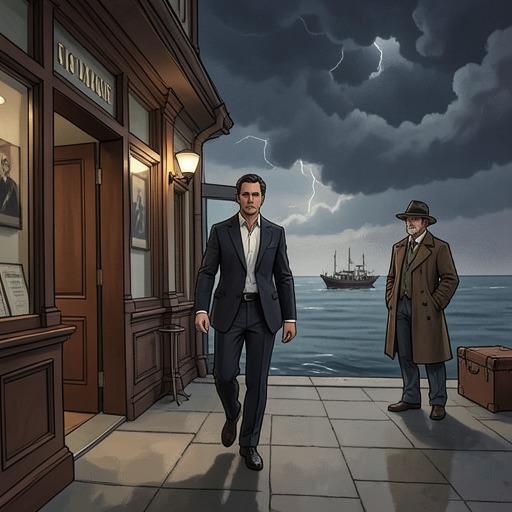
Lauderback was born in London and trained as a lawyer before travelling to New Zealand in 1851. He set out to make a fortune and then increase it, an ambition that suited the rapid opportunities of a young country. In legal circles he was regarded as determined and capable of carrying projects through. He entered the Canterbury Provincial Council and was elected Superintendent by a landslide, building a career around public works and political advancement.
His political commitments were closely associated with large infrastructure projects. As Superintendent, he was expected to direct available funds toward Canterbury priorities, including the Lyttelton tunnel and a projected railway between Christchurch and Dunedin. Those projects made him recognizable within his own political circle, but they also became a point of contrast when he sought office in Westland. In late 1865 he planned to run for the Westland seat in Parliament and asked his friend Thomas Balfour to help him present himself as a local candidate. Balfour was to arrange central Hokitika lodgings, furnish them, and arrange the shipment of a trunk containing law books and papers needed for the campaign.
The request reflects both Lauderback’s political calculation and the personal trust he placed in Balfour. Balfour remembered his elaborate handwriting with amusement and was inclined to forgive what he saw as Lauderback’s extravagance. Their friendship would later become important when Balfour learned troubling details about the Godspeed’s departure but hesitated to disclose Lauderback’s confidence.
Family history and the encounter with Crosbie Wells
Lauderback’s most consequential private secret was his relationship to Crosbie Wells: the two men were paternal half-brothers. Wells had spent years writing to Lauderback, seeking contact, but Lauderback never replied. The correspondence continued for thirteen years. The letters that survived were worn from being folded and refolded, suggesting Lauderback had read them repeatedly even while maintaining his silence.
That silence was not merely an absence of contact. Wells watched his brother advance through the Provincial Council and into Parliament while he lived alone in difficult circumstances. Lauderback kept the letters, but neither answered them nor openly acknowledged the relationship. When he eventually went to Wells’s cottage in the Arahura Valley, he arrived too late: Wells was dead at his kitchen table. Lauderback then travelled to Hokitika, where he told Benjamin Löwenthal that he had found the body. The news prompted Löwenthal to recognize that Wells’s property might soon be sold, helping set in motion the transfer of the estate to Edgar Clinch.
Lauderback’s arrival at the cottage also entered a wider chain of mistaken interpretations. He believed that Wells and Carver were brothers, and that Wells might therefore have been involved in the blackmail that had cost him his ship. In fact, Carver had used the name Francis Wells to make Lauderback believe that they shared a family connection. The revelation that Wells was Lauderback’s actual half-brother makes the deception especially damaging: Carver had turned Lauderback’s unaddressed family longing into leverage, while Lauderback’s own past silence made the false kinship seem plausible.
The Godspeed and Carver’s deception
Carver obtained the Godspeed by presenting himself to Lauderback as Francis Wells. Lauderback later explained that the buyer had used an alias and that the sale document was signed under a false name. The assumed surname drew on Lauderback’s earlier relationship with Lydia Wells, who had been presenting herself as Carver’s wife. Carver’s manoeuvre made the ship transfer more than a transaction: it placed Lauderback under pressure by tying the buyer’s invented identity to a concealed part of his personal life.
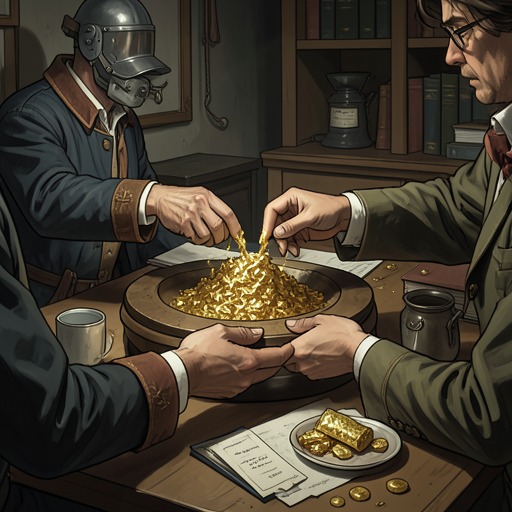
The missing shipping crate prolonged the consequences. It contained a trunk holding about four thousand pounds in gold, carefully sewn into the linings of five dresses. After discovering that the crate had disappeared, Carver travelled to Hokitika and advertised a reward for its return under the name Crosbie Francis Wells, supported by a birth certificate. The narrative leaves uncertain why the blackmail required Carver to assume an alias, and why he possessed Wells’s birth certificate. For Lauderback, however, the false family connection had already done its work: he treated Carver’s supposed relationship to Wells as evidence that Wells might have been complicit in the coercion surrounding the ship.
Lauderback’s belief that the Westland district had turned against him also shaped how he understood the Godspeed’s later wreck. He was intensely superstitious and dated a reversal in his fortunes to the night he found Wells dead. The shipwreck seemed to him proof that the region itself was hostile to his ambitions. The account offers a material explanation for the danger of the Hokitika bar: shifting silt and gravel carried down the Hokitika River continually altered the river mouth. His sense of a curse therefore sits beside a practical hazard, contrasting private interpretation with the changing conditions of the coast.
Public conflict and the exposure of his affair
Lauderback’s political dispute with George Shepard brought his private life into public view. Lauderback accused Shepard of arranging the preliminary construction of the Hokitika gaol-house with money taken from Wells’s estate after Wells’s death, without the consent of public bodies or the investor. His public letter framed the matter as a breach of conduct and called for an explanation. The accusation joined a question of public finance to the contested use of the dead man’s fortune.
Shepard answered by defending the gaol-house as a public work and challenging Lauderback to disclose his former intimate relationship with Lydia Wells, Crosbie’s widow. The counterattack shifted the dispute from the governance of public funds to the reputation of the people claiming a stake in Wells’s estate. Lydia’s inheritance claim had already been weakened by the revelation of her affair with Lauderback; his public confession further damaged her position. Lauderback acknowledged that he had concealed the relationship from voters, apologized, accepted responsibility for the consequences, and expressed regret that he had arrived at Wells’s cottage too late.
The confession does not resolve the estate dispute or repair the damage to Lydia’s claim. It does, however, mark a change in Lauderback’s public conduct: rather than continue to conceal the affair, he accepts its political and personal costs. His response also exposes how intimate relationships become instruments in the struggle over reputation and property. Shepard’s attack is political, but its force depends on details of Lauderback’s private life that he had kept from the electorate.
Recognition and the unfinished apology
Later, Lauderback continued to challenge the validity of Carver’s claim to the Godspeed. He brought a copy of the bill of sale to Balfour and complained that Carver was still pursuing him. He argued that the ship had been sold to a man calling himself Francis Wells, not to Crosbie Wells, and that the false signature made the transaction unlawful. Aubert Gascoigne recognized the personal mechanism behind the alias: Carver had used Lauderback’s former entanglement with Lydia to make the assumed name persuasive.
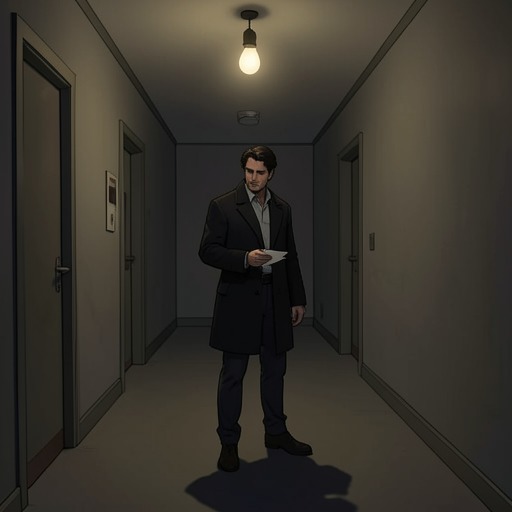
The decisive correction arrives through correspondence. A letter bearing a Hokitika postmark makes clear that Lauderback’s apprehension about Crosbie Wells was false. Until then, he had believed his half-brother to be related on their mother’s side to Carver and consequently suspected Wells of some involvement in the blackmail. The letter overturns that account. Lauderback responds after solemn consideration by beginning a letter of his own, and the narrative places him on the way to meet the brother he had left unanswered for so long. He says he has spent the preceding nine months in Akaroa and has kept away as Wells had requested.
The meeting remains unresolved in the account. Lauderback rehearses an apology and rides toward his brother’s cottage, but the story does not establish that the brothers reconcile. His movement toward Wells nonetheless reverses the defining pattern of their relationship: after thirteen years in which he kept the letters but withheld a reply, he finally prepares to answer. The reversal gives his political ascent a private counterpoint. Publicly, Lauderback has learned to make a name and defend it; privately, the name he misunderstood and the letters he did not answer reveal the human cost of ambition, secrecy, and delayed recognition.